
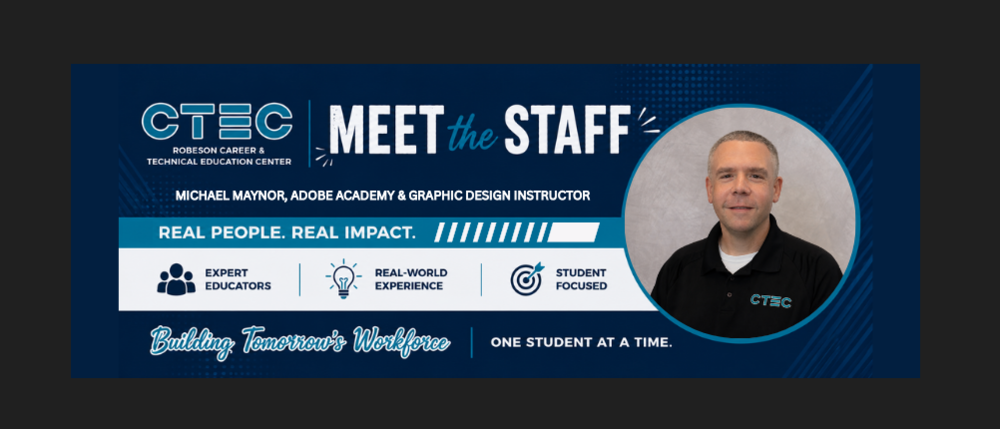
PEMBROKE — In Michael Maynor’s classroom at Robeson CTEC, details matter.
A font that does not quite fit, an image that is slightly out of place or a design that could use another round of refinement is unlikely to escape his attention. As Robeson CTEC’s Graphic Design/Adobe Academy Instructor, Maynor is a stickler for good design — but he is equally passionate about giving students the freedom to be creative.
For Maynor, the two go hand-in-hand.
With 20 years of service to the Public Schools of Robeson County and years of real-world experience as a longtime co-founder of a magazine publication, Maynor brings an industry perspective into the classroom that helps students understand that great design requires both imagination and attention to detail.
“Taking pride in your work is one of the most important things I want my students to learn,” Maynor said. “Your work represents you. I want them to pay attention to the details, take the time to do things well and be able to look at something they created and know they gave it their best.”
Through the Graphic Design/Adobe Academy program at Robeson CTEC, students gain hands-on experience using industry-standard Adobe software while learning principles of graphic design, digital media, branding and visual communication.
But, Maynor does not want every student’s work to look the same.
Instead, he works to help students discover their individual strengths, develop their own ideas and learn how to turn those ideas into polished designs. Creativity, he believes, grows when students are given opportunities to experiment, make mistakes, receive feedback and keep improving.
That balance between creative freedom and high expectations also mirrors what students may encounter beyond the classroom. In professional design environments, creativity must often work alongside deadlines, client expectations, technical requirements and careful attention to detail.
Maynor knows that world firsthand.
His experience as a longtime co-founder of a magazine publication has given him an understanding of the creative process — from developing an idea and establishing a visual identity to designing content that is ready for publication. He now has the opportunity to share that experience with students who may one day pursue careers in graphic design, marketing, communications, digital media, publishing and other creative fields.
But just as important as teaching students the tools of the trade is preparing them for an industry that continues to evolve.
“The creative industry is always changing, so adaptability is incredibly important,” Maynor said. “I want my students to be comfortable trying new things, solving problems and thinking creatively. If they can learn to adapt while still bringing their own ideas and creativity to the table, those are skills they can carry with them no matter where their future takes them.”
At Robeson CTEC, students also have opportunities to work toward industry-recognized Adobe credentials, allowing them to leave the program with more than classroom experience. They can begin building portfolios, technical skills and credentials that demonstrate what they know and what they can create.
For Maynor, some of the most rewarding moments happen when students begin to recognize their own creative potential — when an idea starts taking shape, their confidence grows and they realize the skills they are developing could lead to future opportunities.
At Robeson CTEC, Maynor is helping students understand that good design is about more than making something look good.
“It’s about taking pride in what they produce, remaining open to new ideas and developing the creativity and adaptability to keep growing — wherever their futures may take them,” he said.