
LUMBERTON — The Public Schools of Robeson County (PSRC) is celebrating a significant milestone in its academic turnaround journey. Based on 2026 accountability data, PSRC has exited North Carolina’s low-performing district designation for the first time since the 2017-2018 school year.
The achievement represents years of focused work to strengthen instruction, build leadership capacity, and create more consistent academic outcomes for students across the district.
“This is a tremendous milestone for the Public Schools of Robeson County and a testament to the hard work, determination, and unwavering commitment of our students, educators, school leaders, staff, and families,” said former PSRC Superintendent Dr. Freddie Williamson.
“Just one year ago, we narrowly missed exiting low-performing status by a margin of only 0.08 points. We said then that it was not a time for discouragement, but a time to recognize how far we had come and return to the work with renewed determination. Today, that work has paid off,” he said.
Perhaps one of the strongest indicators of the district's momentum is the number of schools making year-to-year progress. Fifteen schools improved by at least one letter grade in 2026.
PSRC Board of Education Chairman John Simmons said the milestone reflects how far the district has come while also reinforcing the Board’s commitment to continuous improvement.
“This is a proud moment for the Public Schools of Robeson County and for our entire community,” Simmons said. “Our students, teachers, administrators and staff have worked tremendously hard to move this district forward, and the results we are seeing are evidence of that commitment. As a Board, we have remained focused on supporting the work taking place in our schools and ensuring our students have the opportunities and resources they need to succeed. We are going to keep raising expectations, supporting our schools and building on this progress.”
Exiting Low-Performance Designation
Low-performing schools are those that receive a performance grade of D or F even if they meet growth. Low-performing districts are districts where the majority of schools received a performance grade and have been identified as low performing.
To exit the low-performing designation, PSRC needed at least 18 schools to earn a School Performance Grade of C or better. The district surpassed that benchmark with a total of 20 schools meeting the standard used to determine the designation.
“Our progress did not happen overnight. It has been the result of consistent, focused work in our schools and classrooms,” said Dr. Windy Dorsey-Carr, Assistant Superintendent of Curriculum, Instruction, Accountability and Student Services.
“We have worked alongside principals, instructional leaders and teachers to examine student data, strengthen instructional practices and provide targeted support based on the individual needs of our schools. I especially want to thank our teachers, school staff and principals, whose dedication and hard work each day have created meaningful opportunities for our students to learn, grow and succeed. Our educators have embraced this work, and the growth we are seeing across the district reflects their commitment to helping students succeed,” Dr. Dorsey-Carr added.
PSRC Principal Coach Supervisor Amanda Graham works directly with school administrators and instructional leadership teams to strengthen instructional practices and support student achievement. Each week, principal coaches collaborate with school teams, providing targeted feedback and guidance as they analyze student needs, refine instructional strategies, and work to close learning gaps.
“Last year showed us just how close we were, but it also confirmed that the strategies we had implemented were moving us in the right direction,” Graham said. “We continued to refine our approach, identify where additional support was needed, and remain focused on continuous improvement.”
School Performance Grades and Growth Data
The 2026 results demonstrate improvement across several key measures.
PSRC now has one A school, four B schools, 14 C schools, 12 D schools and five F schools. That represents a substantial shift from 2023, when the district had 12 schools earning an F. By 2026, that number had fallen to five. The comparison data also show a continued movement of schools toward higher performance categories.
Student growth data also points to improvement. In the previous year, 13 schools did not meet expected growth; in 2026, that number decreased to eight. At the same time, the number of schools meeting or exceeding expected growth increased from 23 to 28. The same data show a significant shift in School Performance Grades, including growth in the number of B and C schools and a reduction in F schools.
Graduation Rate Improvement
The district demonstrated significant improvement in graduation outcomes from 2024–2025 to 2025–2026, exceeding the state average of 88.8%. The 4-year graduation rate increased from 85.6% in 2024–2025 to 89.2% in 2025–2026, representing a 3.6 percentage-point increase.
Additionally, the 5-year graduation rate increased from 84.5% to 86.7%, a 2.2 percentage-point gain. These increases reflect continued progress in supporting students toward on-time graduation and indicate that district and school-level efforts to monitor student progress, provide targeted interventions, and address barriers to graduation are having a positive impact. Overall, improvements in both the 4-year and 5-year rates show a stronger trajectory toward increasing graduation success across the district.
Measurable Growth
The 2026 results provide evidence that the district's improvement efforts are producing measurable outcomes. The focus remains on strengthening high-quality Tier I instruction, using data to guide instructional decisions, providing targeted support to schools and students, developing instructional leadership, and maintaining high expectations throughout the district.
Coming off the state's low-performing district list represents more than a change in designation. It marks an important chapter in PSRC's turnaround journey and reflects the collective work of students, teachers, school leaders, support staff, families, the Board of Education, and the broader Robeson County community.
Looking Ahead
While exiting the low-performing district designation is an important milestone, district leaders recognize that the work is not finished.
“Exiting low-performing status means the systems and structures we have put in place are producing results, and it gives us even greater confidence in what we can accomplish together. This achievement belongs to every person who has continued to believe in our students and push toward excellence. We are moving forward as one team with one goal—ensuring every student in Robeson County has the opportunity to succeed,” Dr. Williamson said.
District leaders consider the milestone as both a reason to celebrate and a call to continue the work. The district enters the 2026-2027 school year with evidence of significant progress, a clearer picture of where additional support is needed, and a commitment to building on the momentum already underway.
“Meaningful improvement requires time, consistency, and a shared commitment to doing what is best for students. We are proud of the progress our schools have made, and we remain committed to strengthening instruction and supporting the continued growth of every student,” said Dr. Debra Dowless, PSRC Director of Curriculum and Instruction.
“We know sustainable progress is built over time, and our responsibility is to ensure that progress continues,” Dr. Dowless added.
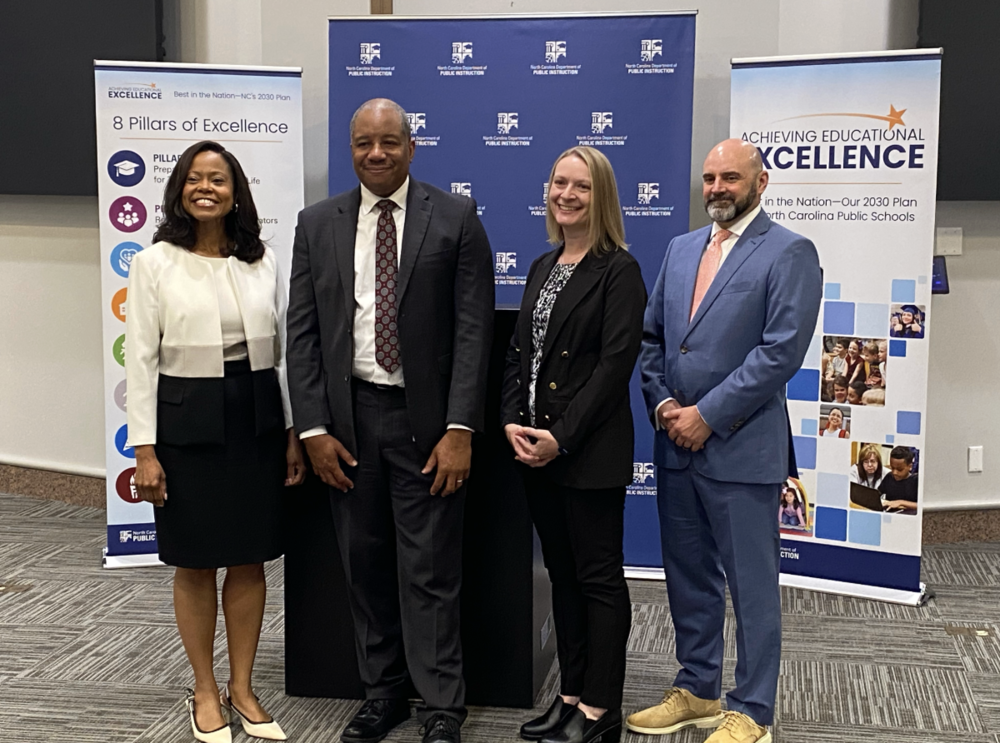
Photo Caption: Following a press conference in Raleigh on Wednesday about North Carolina’s 2025-26 accountability results, Dr. Windy Dorsey-Carr, Assistant Superintendent of Curriculum, Instruction, Accountability and Student Services, third from left, stands with State Superintendent of Public Instruction Maurice “Mo” Green, Charlotte-Mecklenburg Schools Superintendent Dr. Crystal Hill and NCDPI Chief Accountability Officer Michael Maher.
During the press conference, Dorsey-Carr shared celebratory remarks and highlighted the focused work taking place across the Public Schools of Robeson County that contributed to the district exiting North Carolina’s low-performing district designation for the first time since the 2017–18 school year.